skip to main |
skip to sidebar
Realized I hadn't posted anything in a while so did this little drawing.
-Hat
Following up on the last post, here's a little piece I did inspired by Ken Sugimori.
 I did a version that I had shaded, but liked this one with the flat color better.-Hat-Man-Do
When I heard they were making a whole new generation of Pokemon I was pretty excited. I've been a fan of the franchise for a long time due in most part to the artwork and character design of lead Pokemon artist Ken Sugimori.
This guys is amazing. The amount of character he can convey in a single pose is mind-boggling. There are certain Pokemon he has designed and posed to an extent such that you know all you need know about that particular character from one drawing.
 He has crafted, with Pokemon in particular, a style that is beautifully minimalistic yet complex at the same time, specifically in the anatomy, which contains brilliant subtleties all while maintaining the overall appeal. The hierarchy of details in his designs is unmatched. He has an uncanny ability in understanding where high volume areas of detail, as well as low volume areas, need to be in order to suggest types of fabric/skin/fur all without drawing attention to itself and distracting from the overall harmony of the design.
When I saw the 5th generation of pokemon I was, to say the least, underwhelmed with most of the designs. It's not that they were bad per say, it had more to do with the concepts behind a majority of them which seemed somewhat questionable for what I knew as 'Pokemon'. However, I got over my initial uncertainties about them, and at this time most of them have grown on me. So I decided to draw a few.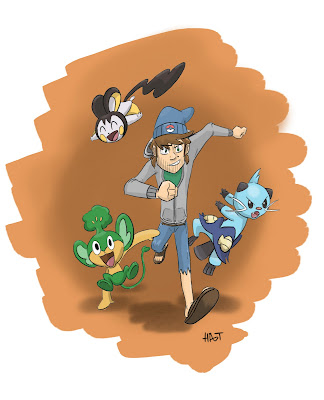 -PokeHat
They are having a screaming contest, for keeps! -Hat
-Hat
HiHappy new year! Thanks to all the peoples who stopped by my blog this past year, you are awesome. I hope this year I get a chance to meet some of you that I only know by artwork.May all your dreams come true, and all that is true become a dream... not sure what that means but it sounded good.-Hat
Random Manny's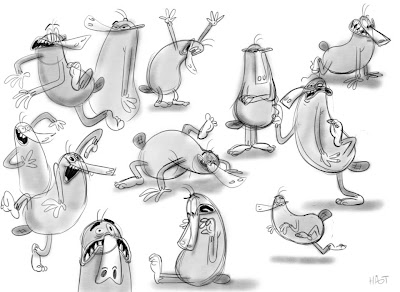
Just a buncha random Khan doodles.
I been drawins Manny and Khan quite a bit lately, as me and Joe-dawg are working on some new Chronicle comics. These are some warm up doodles I did. Hopefully we'll have something to post soon. -Hat-Man
Just a random little doodle I did during the day.
The new adventures of Bianca-Llama and Beaver Boy (Add your own sound effects, it makes the drawing better).
-Hat
The residents of super-cube as animal themed super heroes. This is just one of those drawings that gets made after I say something stupid at the studio. Note: The Bobcat is a super-villain_Hat a.k.a Beaver Boy
Found this old doodle I did of Khan that made me laugh, so I cleaned it up real quick... _Hat
_Hat
A couple a' Manny and Khan comic strips me and Joey made;
 -Hat
-Hat
Motivating the Camera: Part 2.Continuing with the previous post, these examples revolve too around motivating the camera, however explores more "what they are saying visually".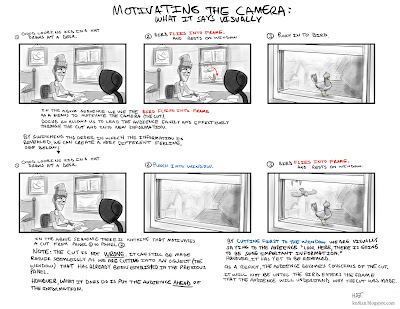 The next three examples are all slight variations of the same scene, each exploring a different approach in regards to the progression of information that is revealed to the audience, and consequently the effect it has on them. Please note that none of these examples are any more "right" than any other. They are merely different takes on the same scene. Their purpose is to show how slight variations in storyboards (and ultimately film) can produce vastly differing ideas/moods. Ultimately, it would all depend on what the script calls for or what is necessary of the scene to determine which of the following (if any) would be suitable.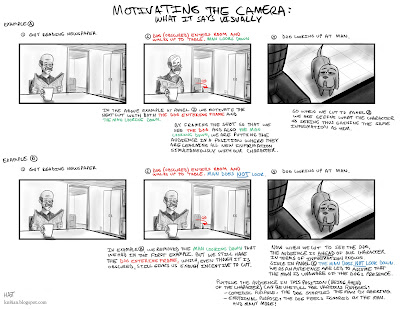
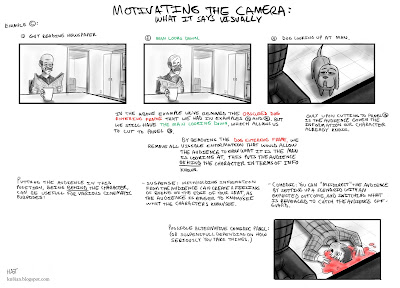 I think the most important thing to take away from this concept of 'motivating the camera', is just to try and be conscious of the decisions you are making in your storyboards. Try to understand what you are actually saying visually, what information you are revealing to the audience (and when) and what effect it will have on them. Thinking about these things as you board can really help enhance a sequence and 'sell' an idea in the storyboard stage.On a side note: None of these tips/theories/methods I've discussed are "rules". They are by no means absolute. There are no 'right' or 'wrongs' with storyboarding, as I've stated before, simply ways that work better than others at achieving desired responses. As much as I use these principles and incorporate them into my own sequences, I find myself quite frequently deviating, or cheating, or bending these ideas. I rely much more on the 'feeling' of a sequence as I board. Boarding panels and flipping through them to see how I 'feel' watching it, to see if the cuts are smooth, or if something doesn't 'feel' right. So take these tips for what they are worth, simply tips, tricks and principles I have found to be sucessful.
-Hat
The next couple posts revolve around 'motivating the camera'. What is motivating the camera you might ask? Good question, you get a gold star.*Motivating the camera is a simple technique of using visual cues to set up a cut or camera-move and in doing so, ease the audience into a new shot or new information.
Below is a simple example of how utilizing the above theory can have a huge influence on the overall feel/continuity of a sequence.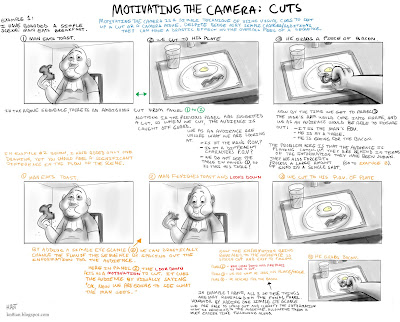
I think I made it a bit overly-complicated. Just look through each of the examples and feel the difference.
Basically: Use a character's eye line to motivate a cut. It helps ease the audience through the cut and into new information. (While also putting us directly in the character's shoes)
There are many other ways to motivate the camera. Below is a short sequence I've boarded out with various examples all strung together. The idea is to create as much continuity within the sequence as possible, making everything clear and easy to follow.
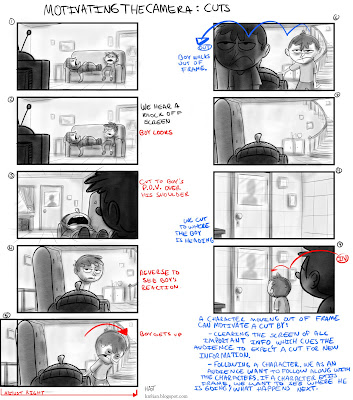 Below I have pointed out the specific methods used to motivate the camera.
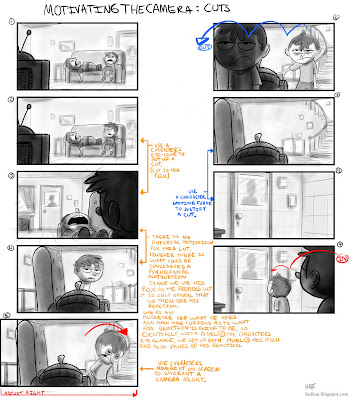 So as per the above sequence, ways to motivate the camera;- Using a Character's eyeline/P.O.V.
- Having a character move on screen and adjusting the camera accordingly.
- Having a character exit frame.
There are other ways not represented in the above example, for instance;
- Having a character enter frame. (This will be illustrated in a future tip sheet.)
I think ultimately what it comes down to, specifically for 'cutting', is the fact that a 'cut' is not natural, it doesn't happen in real life (unless you take really long blinks). Obviously we have seen enough film/television that we are accustomed to 'cutting', nevertheless, anything you can do to smooth out the transition will only help create and maintain the continuity of your sequence.
To be continued shortly...
* Gold stars are neither gold nor stars and consist almost entirely of your imagination.
This is a quick little comic retelling I did of a recent monumental event to transpire at the studio.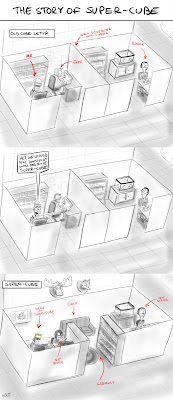
As mayor of super-cube my responsibilities include:
- making of the mayoral crown
- wearing of the mayoral crown
Super-cube is the greatest idea I've ever had.
-Mayor McJewburger
My Cubie was having technical difficulties with his computer today and had to move to a different cube to work... I hope he comes back soon...

 I did a version that I had shaded, but liked this one with the flat color better.
 He has crafted, with Pokemon in particular, a style that is beautifully minimalistic yet complex at the same time, specifically in the anatomy, which contains brilliant subtleties all while maintaining the overall appeal. The hierarchy of details in his designs is unmatched. He has an uncanny ability in understanding where high volume areas of detail, as well as low volume areas, need to be in order to suggest types of fabric/skin/fur all without drawing attention to itself and distracting from the overall harmony of the design.


 Below is the clip, the first 35 seconds is the stuff I boarded. The animation team did an amazing job matching and enhancing the poses and shots I boarded.
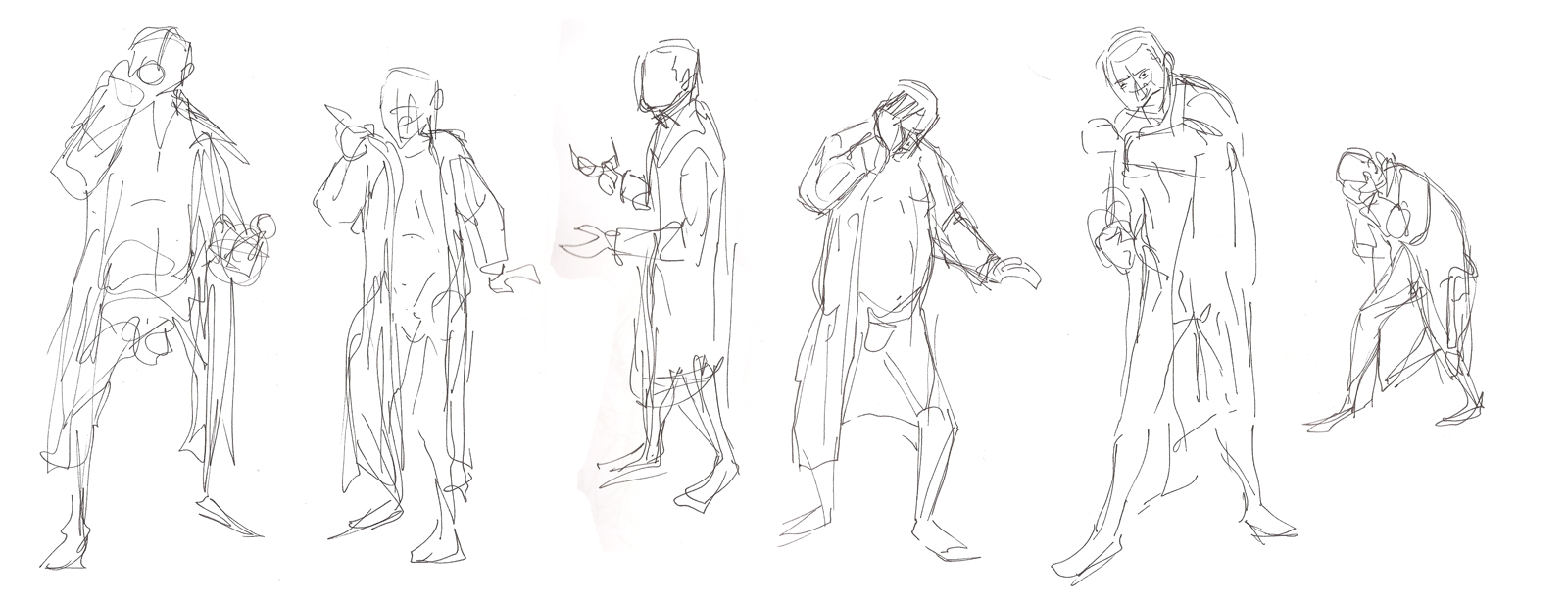
 Some 1 and 2 minute gesture drawings;
 Random sketch book page;
 A couple caricatures I did for and of some dudes at the studio;

 Thanks to all the peoples who stopped by my blog this past year, you are awesome. I hope this year I get a chance to meet some of you that I only know by artwork.
 (Add your own sound effects, it makes the drawing better).
 Note: The Bobcat is a super-villain

 Hope you enjoyed the antics of these idiots.
 _Hat
_Hat
 There was something about rich pets that I thought was funny.


 Below I have pointed out the specific methods used to motivate the camera.
 So as per the above sequence, ways to motivate the camera;


 Note: there would obviously be more panels if this was flushed out, to play up the acting and also hook up the action. And on the last panel, I would probably frame it more centered while the female is farther away and then adjust right as she walks towards camera.
 As long as you continue to establish any new screen spacing, the sequence should maintain a certain level of continuity that will allow the audience to follow along quite easily.